Ice Machine Not Making Ice? Find the Stage That Stopped
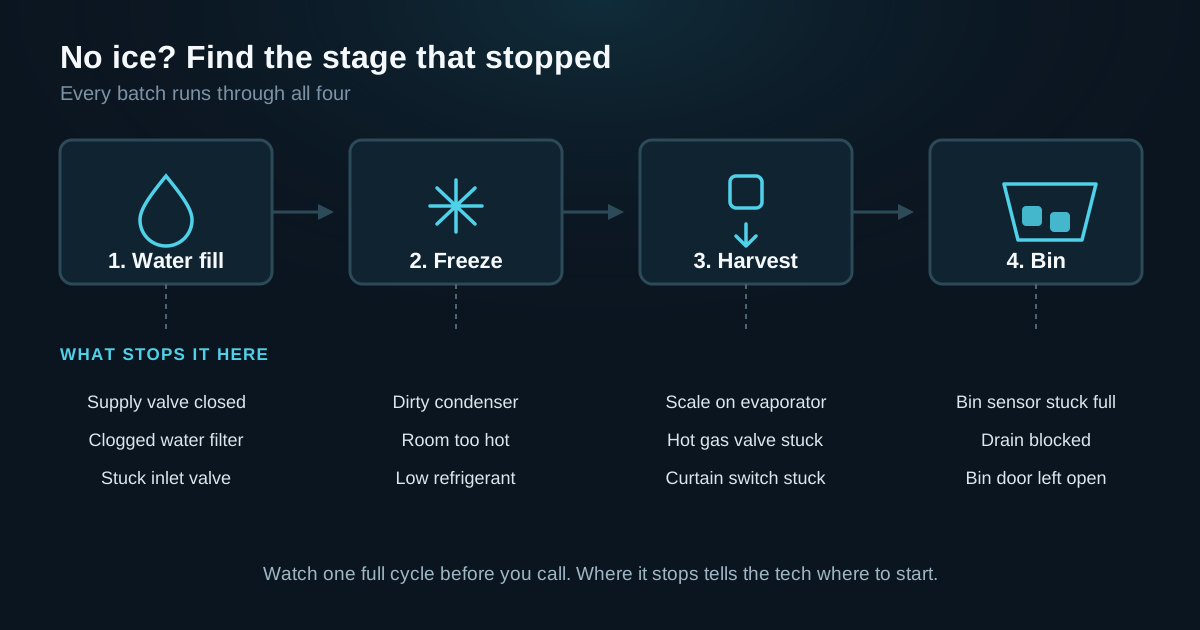
When the bin is empty in the middle of service, the instinct is to call it a dead machine. It usually is not. An ice machine makes every batch by running the same four stages in order, and when production stops, it stops at one of them. Watching a single cycle tells you which, and that one observation can save a tech an hour of diagnosis.
The four stages
Water fill. The machine takes in water and fills the sump or distributes it over the evaporator. Freeze. Refrigerant chills the evaporator and ice builds up on it. This is the long part of the cycle. Harvest. The machine warms the evaporator surface just enough for the ice to release and drop. Bin. The ice lands in storage, and the bin control decides whether to run another batch.
Watch one cycle from the start and see how far it gets. Here is what stops it at each stage.
Stage 1: it never takes on water
If you can hear nothing filling and the evaporator stays dry, the problem is upstream of the refrigeration entirely.
- The supply valve is closed. Check the shutoff behind or under the machine. After any plumbing work or a deep clean, this gets left off surprisingly often.
- The water filter is clogged. Filters restrict flow long before they stop it completely, so the first symptom is usually thin or undersized cubes, then no fill at all. Around Tyler the water is hard, and filters load up faster than the calendar suggests.
- The inlet valve has failed. This is the machine’s own valve, and it needs a tech.
Stage 2: it fills, but never freezes
Water goes in, the cycle runs long, and nothing builds on the evaporator.
- The condenser is dirty. Same story as every other piece of refrigeration: a coil that cannot shed heat cannot make cold. Pull the panel and look.
- The room is too hot. Ice machines are rated for a certain air and water temperature, and a machine crammed into a hot back corner with no clearance will underproduce all summer. If production drops every July and recovers in October, this is your answer.
- Refrigerant is low. A leak means a tech, and it means the machine was losing capacity for a while before it stopped.
Stage 3: it freezes, but never releases
There is ice on the evaporator, but it never drops into the bin, so the machine sits in an endless freeze cycle. This is the stage people most often mistake for a dead compressor, and it is usually nothing of the sort.
- Scale on the evaporator. Mineral buildup makes ice cling instead of sliding free. In hard water this is the usual culprit, and it is also why cubes go cloudy long before they stop coming.
- The hot gas valve is stuck. That valve is what warms the surface for release. If it does not open, the ice has no reason to let go.
- The curtain or thickness control is stuck. The machine uses it to decide when the batch is done. Stuck in one position, it never calls for harvest.
Stage 4: it makes ice, but the bin stays empty
- The bin control thinks the bin is full. A stuck sensor or thermostat will shut production down on a bin with three cubes in it.
- The drain is blocked. Meltwater backs up, and the ice you made sits in a puddle melting as fast as it arrives.
- The bin door is being left open. Not a repair, but worth ruling out before you pay for one.
What to check before you call
Give it ten minutes and a flashlight:
- Confirm the water supply valve is open.
- Check when the filter was last changed.
- Pull the front panel and look at the condenser coil.
- Watch one full cycle and note the stage where it stalls.
- Look for scale on the evaporator and standing water in the bin.
What to tell the tech
Lead with the stage. “It fills and freezes but the ice never drops” points straight at harvest, and a tech can arrive with the right parts instead of diagnosing from scratch. Add the model number and roughly when production started slipping, because a machine that faded over three weeks tells a different story from one that quit on Tuesday.
We handle commercial ice machine repair across Tyler and East Texas, and scheduled preventive maintenance with descaling is what keeps hard-water scale from reaching the point where the harvest stage quits.