Repair or Replace a Commercial Cooler? How to Decide
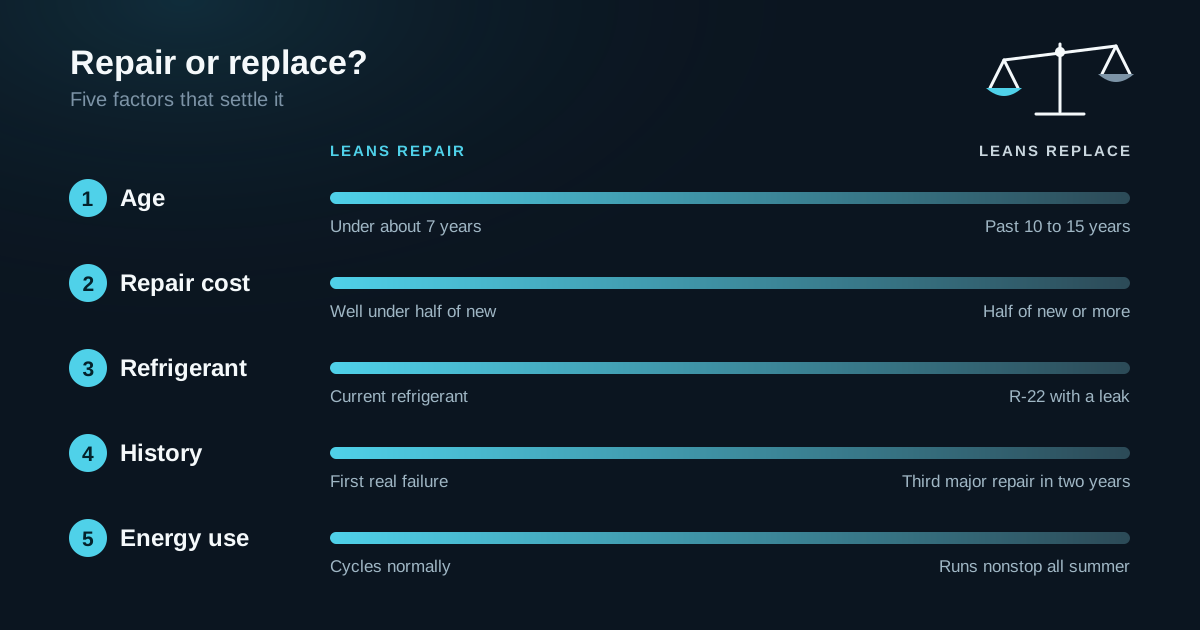
The tech has the panel off, the compressor is done, and the quote is a real number. On a three-year-old reach-in that is an easy call. On a unit that has been running since before your current menu, it is not. There is no universal answer to repair or replace, but five factors settle it for most commercial kitchens, and none of them require guessing.
1. How old is the equipment?
Commercial refrigeration commonly runs somewhere around 10 to 15 years with reasonable care. A major repair in year four is buying back a machine with most of its life ahead of it. The same repair in year fourteen is buying time on a unit where every other part is just as old as the one that failed.
Walk-ins are a special case, because the box and the refrigeration system are two separate decisions. Sound panels, tight seams, and a floor that is not soft can outlive two or three condensing units. When a walk-in system fails, you are almost never deciding whether to replace the walk-in. You are deciding whether to replace the equipment bolted to it.
2. What does the repair cost against a new unit?
The common rule of thumb: when a repair runs about half the cost of a comparable new unit, and the equipment is past the middle of its life, replacement usually wins. It is a starting point, not a law, but it trips most often on the expensive repairs, compressor replacements especially.
Compare against a real number, not a catalog price. A fair replacement figure includes the unit, delivery, installation, haul-away of the old one, and any electrical changes the new unit needs.
3. What refrigerant does it run on?
This is the clearest signal of the five. R-22 is no longer produced or imported in the United States, so every recharge draws on a shrinking supply. An R-22 system with a leak is very close to an automatic replace.
Many units built in the 2000s and 2010s run R-404A, which is being phased down under federal rules while newer equipment moves to lower-impact refrigerants. Leak repairs on R-404A systems are still routine today. On an older unit with a history of leaks, though, it belongs on the replace side of the scale.
4. Is this the first failure or the fourth?
A single failure on a unit with a clean service history is a repair. A unit that has needed a fan motor, a thermostat, and a leak repair in the past two years is telling you something about the rest of it.
When you add it up, count the full cost of each breakdown, not just the invoice: the product you threw out, the menu items you pulled, and the service you ran short. Keeping dated service records makes this factor easy to judge instead of a matter of memory.
5. What is it costing to run?
An older unit with tired door seals and a worn compressor runs longer to hold the same temperature. On equipment that works hard all day, and in an East Texas summer that is all of it, the difference in power use against a current ENERGY STAR certified model can be meaningful. A unit that never seems to cycle off in July is costing you money even when it is technically holding temperature.
When repairing is clearly right
- The unit is younger than about seven years.
- The failed part is a common one: a fan motor, a thermostat, a gasket, a defrost control, or start components.
- The service history is otherwise clean.
- For a walk-in, the panels and floor are sound.
When replacing is clearly right
- It is an R-22 system with a leak.
- The compressor failed on a unit well past ten years.
- This is the third major repair in about two years.
- The cabinet is rusting, the insulation has failed, or the box sweats on the outside.
The middle ground: buy time on purpose
Sometimes the answer is replace, just not this week. A repair that carries a unit through the busy season can be the right move, as long as everyone knows that is what it is. Plan the replacement for a slow month on your schedule instead of a July Saturday on the equipment’s schedule.
Get a straight answer
The most useful thing a tech can tell you is when a repair is not worth doing. Ask directly for both numbers, the repair and the replacement, and which one they would choose if it were their kitchen.
We handle walk-in cooler repair and reach-in cooler and freezer repair across Tyler and East Texas, and when replacing is the better call, refrigeration installation with the old unit hauled away. If the unit is down right now with product inside, that is an emergency call, and the repair or replace conversation can wait until the box is cold.