Cooler Making Noise? What Each Sound Means
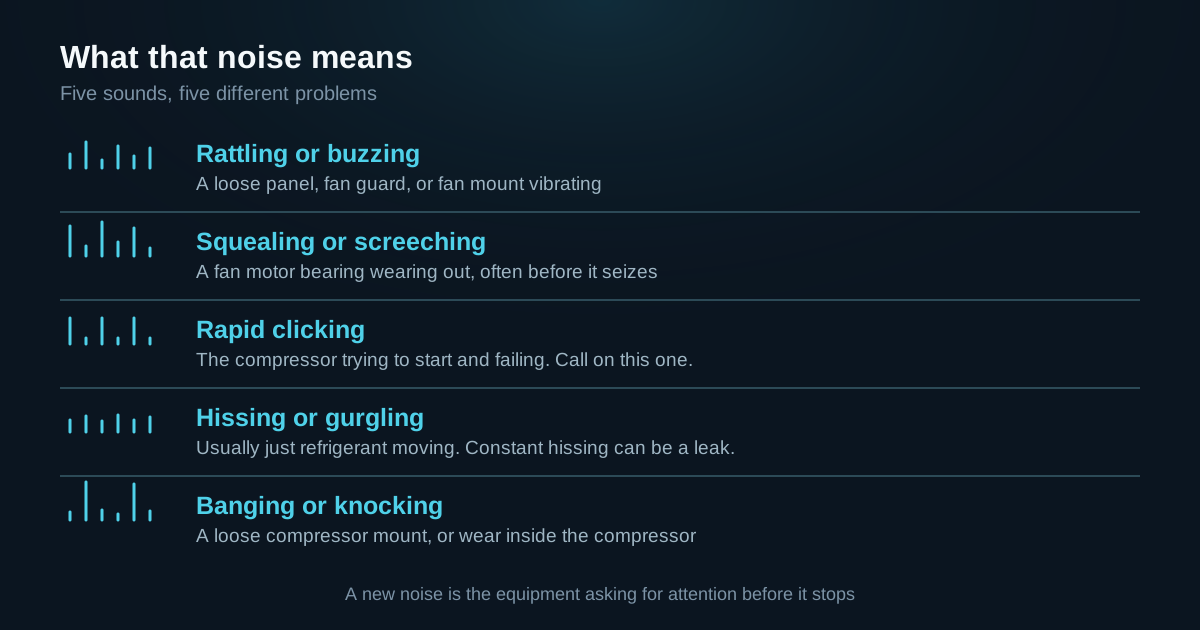
Refrigeration is never silent. Fans turn, compressors cycle, refrigerant moves. The thing worth paying attention to is not noise, it is a new noise, because equipment almost always changes its sound before it quits. Here is how to read the five you are most likely to hear, and which one should end the conversation and start a phone call.
Rattling or buzzing
Usually the cheapest problem on this list. Something is loose and vibrating against something else: an access panel, a fan guard, a bit of tubing, or the fan mount itself.
Find it by tracing the sound while the unit runs. If it stops when you rest a hand on a panel, you have it. Tighten the fasteners and listen again.
Worth doing promptly, though. A loose fan blade is one rattle away from making contact with its housing, and that turns a two-minute fix into a fan assembly.
Squealing or screeching
A high, metallic complaint, usually loudest right at startup. This is nearly always a fan motor bearing wearing out, either the evaporator fan inside or the condenser fan outside.
This is a warning with a short fuse. When that bearing seizes, the fan stops, and a condenser fan that stops means the system cannot shed heat. You lose the box not long after. Replacing a fan motor on your schedule costs a fraction of replacing it during Saturday service with a walk-in full of product.
Rapid clicking
Listen for a click, a brief hum, then silence, repeating every few minutes. That is the compressor trying to start and failing, and it is the one noise on this list where the right move is to stop.
Each attempt draws heavy current through a compressor that is not turning. Letting it keep cycling, or resetting the breaker to give it another go, can take a failed start component, which is an affordable repair, and turn it into a failed compressor, which often means replacing the unit. Switch it off at the thermostat and call.
Hissing or gurgling
Most of the time this one is nothing. Refrigerant changing state and moving through the lines gurgles, and you will often hear it right after the compressor shuts off. A trickle of water during defrost is normal too.
Two versions are not normal. A steady hiss that does not come and go with the cycle can mean refrigerant escaping, and a leak will show up as a box that slowly loses its ability to hold temperature. The other is a hiss paired with an oily film on the lines or fittings, which is the classic sign of a leak that has been going for a while. Both need a tech, and neither is an emergency the way the clicking is.
Banging or knocking
A heavy, irregular thump from the condensing unit. Sometimes it is a loose compressor mount, which is a straightforward fix. Sometimes it is wear inside the compressor itself, which is not.
A single clunk when the unit starts or stops is usually just the system settling. Repeated banging while it runs is worth a look, and worth it soon.
Quick reference
- Rattle or buzz: loose part. Find and tighten it.
- Squeal: fan bearing. Schedule a replacement before it seizes.
- Rapid clicking: compressor failing to start. Shut it down and call.
- Hiss: usually normal. Constant, or with oily residue, means a leak.
- Bang or knock: loose mount, or compressor wear. Get eyes on it.
Why the new sound matters
Every item above is cheaper to deal with as a noise than as a failure. A fan motor caught while it squeals is a planned visit. The same motor caught after it seizes is an emergency with product on the line, and in an East Texas summer the box behind it does not have long.
Train whoever opens in the morning to notice when the kitchen sounds different. It is the cheapest diagnostic tool you own.
We handle walk-in cooler repair and reach-in cooler and freezer repair across Tyler and the surrounding towns, and 24/7 emergency service for a unit that quits in the middle of service.