Prep Table Not Cold? 5 Reasons Sandwich Units Warm Up
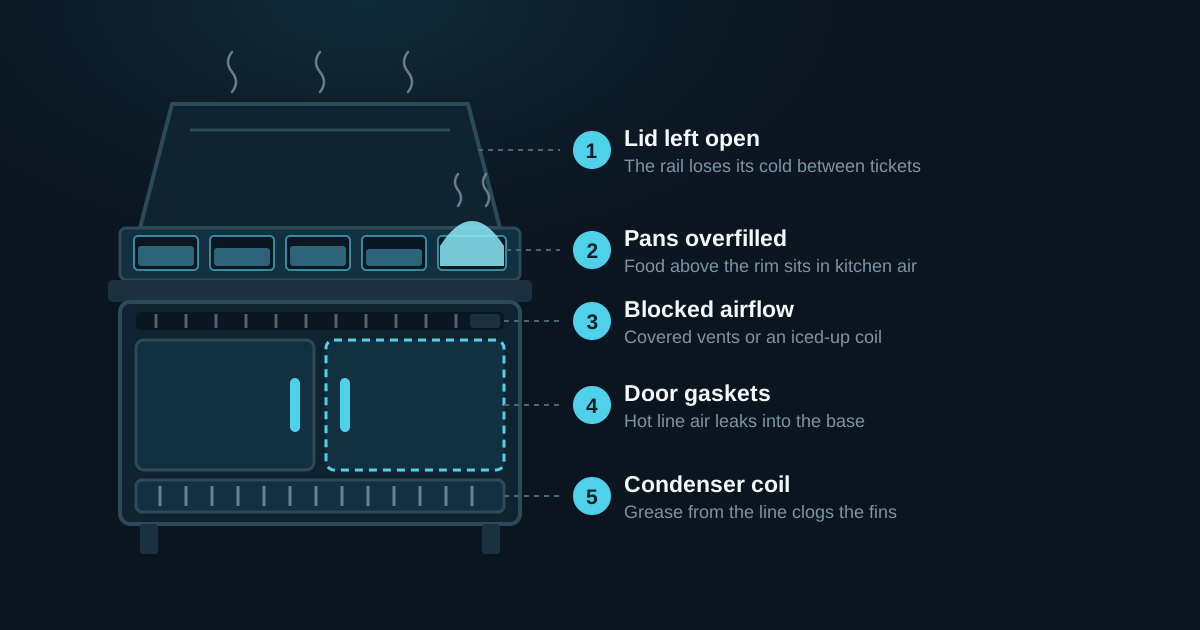
The sandwich or pizza prep table is the hardest-working piece of refrigeration in most kitchens. The lid is open for most of service, the pans get refilled all day, and the whole unit usually sits a few feet from the fryer or the oven. It is also where a health inspector is most likely to push a probe thermometer. When the pans start running warm, the cabinet underneath can still read perfectly fine, which is exactly why the problem goes unnoticed.
How a prep table keeps the pans cold
The base cabinet is an ordinary refrigerator. The pans on top are the hard part. On most units, cold air from the evaporator in the base is pushed up and around the pans in the rail, and the lid holds that cold in whenever it is closed. Anything that breaks that loop shows up first in the pans, not in the cabinet.
Here are the five usual causes, from the top of the unit to the bottom.
1. The lid stays open
Leaving the lid up between tickets feels harmless, but the rail cannot hold temperature in open kitchen air for long, especially beside a hot line. Close the lid during every lull and always overnight. If the pans recover after the lid has been shut for a while, habits were the problem, not the equipment.
2. The pans are overfilled
Product mounded above the rim of the pan is sitting in room air, not in the cold zone. Keep food below the rim, use the pan depth the unit was designed for, and make sure every opening in the rail has a pan in it so cold air is not escaping through the gaps. Loading prepped food that is still warm also sets the whole rail back, so chill ingredients before they go in the pans.
3. The airflow is blocked
If the vents that carry air up to the rail are blocked by wrapped product, or the evaporator coil in the base has iced over, the pans lose their supply of cold air. A coil packed with ice usually points to a defrost problem or a door that has been left ajar. Pull stored product back from the vents, and if you see a solid block of ice on the coil, leave it for a tech rather than chipping at it.
4. The door gaskets are worn
The doors on the base take a beating from knees, carts, and constant opening. Once a gasket is torn or hardened, hot air from the line leaks straight into the cabinet, and the unit has less cold to send up to the rail. Close each door on a dollar bill: if it slides out with no drag, that gasket is not sealing.
5. The condenser coil is clogged
This one is last on the list but first in how often we see it. The condenser coil sits behind the front grille of the base, right where the air around a fryer or flat top drifts. Grease and dust coat the fins until the unit cannot shed heat, and it starts losing the fight on the hottest afternoons. Unplug the unit, pull the grille, and brush or vacuum the coil. In a busy kitchen this may need doing every couple of weeks.
What to check before you call
- Close the lid for an hour and probe the pans again.
- Look at how full the pans are, and whether any rail openings are empty.
- Pull the front grille and look at the condenser coil.
- Check the vents in the base and the evaporator coil for ice.
- Run the dollar bill test on each door.
When it needs a tech
Call if the pans are still above 41°F after the lid has been closed for an hour, if the base cabinet is warming along with the rail, if the evaporator coil is a block of ice, or if the compressor seems to run nonstop without catching up. Those point to a refrigeration problem rather than a habit, and product in the rail is already on the clock.
We repair sandwich and pizza prep tables as part of our reach-in cooler and freezer repair service across Tyler and East Texas, and when the rail is warm in the middle of service, that is an emergency call. To keep it from happening again, work the coil cleaning and gasket checks from our refrigeration maintenance checklist into your monthly routine.