Commercial Refrigeration Maintenance Checklist
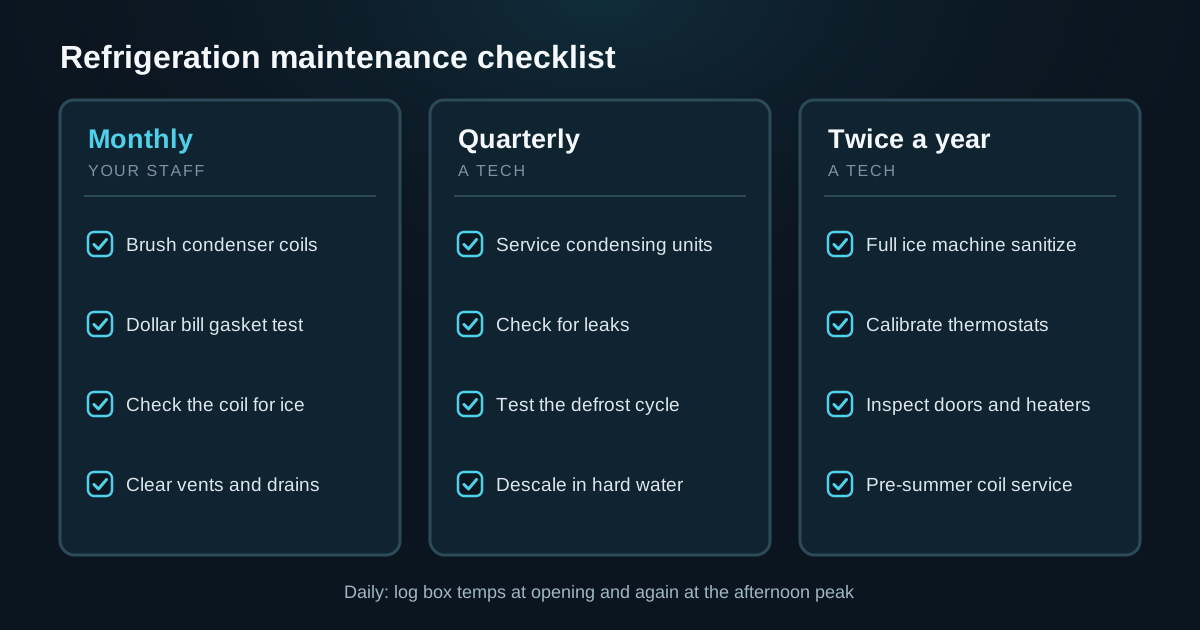
Most refrigeration breakdowns announce themselves weeks ahead: a coil that is getting dusty, a gasket that no longer seals, a box that runs a little warmer every afternoon. A maintenance checklist is simply a way of looking for those signs on a schedule instead of finding them on a Friday night. Here is one built for commercial kitchens in the Tyler area, split between what your staff can handle and what needs a refrigeration tech.
Daily: log your temperatures
Record the temperature of every cooler and freezer twice a day: once at opening and once at the afternoon peak. The morning reading tells you the box recovered overnight. The afternoon reading tells you whether it can actually keep up with service, which is the number an inspector is going to see. A slow upward creep in the afternoon log is usually the first sign that something on this list is overdue.
Monthly: your staff can do these
- Brush the condenser coils. On reach-ins and prep tables the coil sits behind the front grille or kick plate. With the unit unplugged, brush or vacuum the dust and lint off the fins. Units next to a fryer or flat top pick up grease fast and may need this every two weeks.
- Run the dollar bill gasket test. Close each door on a dollar bill and pull it out. If it slides out with no resistance, that section of gasket is not sealing. Check every side of every door.
- Check the evaporator coil for ice. A light frost is normal on a freezer. A solid block of ice on a cooler coil, or ice that keeps building, points to a defrost or airflow problem.
- Clear vents and drains. Pull product back from the evaporator fans and air returns, and look for standing water in drain pans or around the base of the unit.
Quarterly: have a tech handle these
- Service the condensing units. Walk-in condensing units, whether on the roof or behind the building, need their coils cleaned and their fan motors checked. Spring pollen and summer dust load them up quickly.
- Check for leaks. A tech checks system pressures and looks for the oily residue that marks a slow refrigerant leak before it becomes a warm box.
- Test the defrost cycle. Confirm that defrost starts, heats, and ends when it should. A defrost cycle that does not terminate properly is behind a lot of iced coils and warm afternoons.
- Descale ice machines in hard water. Much of the water around Tyler is hard, and busy machines scale up fast. Quarterly descaling keeps production up and cubes clear.
Twice a year: the deeper service
- Fully clean and sanitize ice machines. Manufacturers typically call for this at least twice a year, and ice is food, so it matters for more than production.
- Calibrate thermostats and controls. A control that has drifted a few degrees can hold a box at a number that looks fine on the display and fails a probe test.
- Inspect doors and heaters. Hinges, closers, door heaters, strip curtains, and on walk-ins the panels and floor. A door that does not self-close is a gasket problem waiting to happen.
- Do a full coil service before summer. Late spring is the time for a complete condenser cleaning and check, before the first 95 degree week puts every system in town at its limit.
Adjust it to your kitchen
This is a baseline, not a rule. Kitchens with heavy fryer or grill use should brush coils more often. High-volume bars may need ice machine descaling more often than quarterly. Equipment that sits right beside the hot line works harder than the same model across the room, so it earns more attention.
Keep a written record
Log the date and what was done for every task. The record helps at inspection time, it helps with warranty claims, and it makes the repair or replace decision much easier when a unit finally does fail, because you can see its whole history at a glance.
What the checklist buys you
Almost every emergency call we see traces back to something that would have shown up on this list: a packed coil, a torn gasket, a slow leak, a defrost cycle that quit. Catching those on a Tuesday morning costs far less than catching them with a full walk-in on a Saturday night.
If you would rather hand the tech side of this list to someone else, our refrigeration preventive maintenance visits cover it on a set schedule across Tyler and East Texas, and hard-water scale is handled as part of commercial ice machine service. For more on the afternoon temperature problem, see what health inspectors check on walk-in coolers.