Winter Refrigeration Problems in East Texas
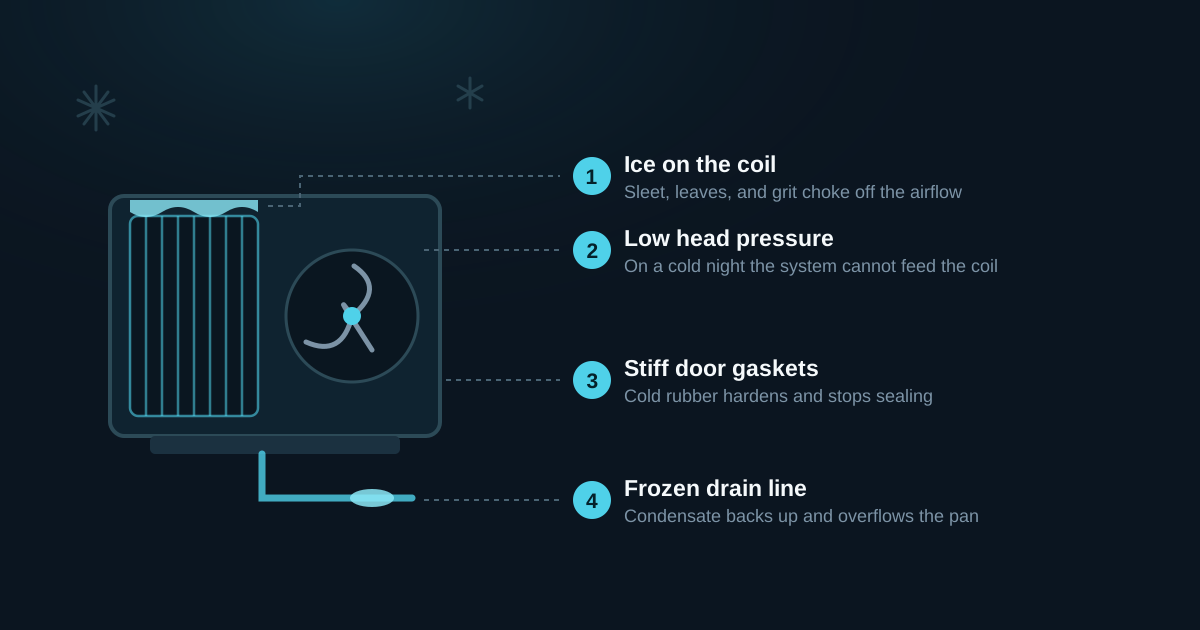
Everyone expects refrigeration trouble in July. Fewer kitchens expect it in January, which is why winter failures tend to catch people off guard. A walk-in that sailed through the summer can start struggling the first week the overnight temperature drops, and the reason is not that the equipment got weaker. It is that refrigeration systems are designed around shedding heat into warm air, and cold air changes the math.
Here is what goes wrong once the weather turns, and what to do before it does.
Low head pressure: the one nobody expects
This is the big one, and it is counterintuitive enough that it is worth explaining properly.
An air-cooled condensing unit works by pushing heat out into the surrounding air. On a hot day that is hard work, so the system runs at high pressure. On a cold night it is easy, and the pressure on the high side falls. That sounds like good news, but the system needs that pressure to push refrigerant through the expansion valve and into the evaporator. When it drops too far, the coil gets starved, and the box warms up.
The symptom is strange enough to be a useful clue: a cooler that holds fine during the day and drifts warm overnight, when the outside air is coldest. If that pattern sounds familiar, the fix is not more cooling. It is head pressure control on the condensing unit, usually fan cycling or a variable speed condenser fan, and it needs a tech.
Units mounted outdoors or on the roof are the ones affected. An indoor condensing unit in a heated building never sees the problem.
Frozen condensate drain lines
Every cooler produces condensate, and it has to drain somewhere. When that line runs outdoors or through an unheated space, a hard freeze can plug it with ice.
The water does not stop arriving just because the drain stopped working, so it backs up. You get an overflowing drain pan, water on the floor inside the box, and ice forming where it collects. Left alone it refreezes into a larger blockage.
Drain lines in exposed runs should be insulated, and lines prone to freezing can be fitted with heat tape. If you are already mopping up water, read why your cooler is leaking for the non-winter causes too, because a clogged line looks the same whether ice or grease caused it.
Ice and debris on outdoor coils
Outdoor condensing units collect whatever the season brings. Autumn leaves pack into the fins, then sleet and freezing rain cement the whole mess in place. The unit cannot breathe, and when a warm afternoon arrives, it suddenly has to work hard through a blocked coil.
Check outdoor units after any storm. Clear leaves and debris from around the base, and make sure nothing is stacked against the unit for winter storage, which happens constantly.
Never chip ice off a coil or pour hot water on it. The fins bend easily and the tubing punctures easily, and either turns a cleaning into a repair.
Door gaskets go stiff
Rubber hardens in the cold. A gasket that sealed acceptably in August can lose contact in January, especially on a walk-in with a door to an unheated back area. The seal breaks, humid air leaks in, and you get ice around the door frame and a box that works harder than it should.
Run the dollar bill test on every door when the weather turns, the same test as in the maintenance checklist. A gasket is one of the cheapest parts on the unit and one of the most consequential.
The East Texas wrinkle
Our winters are mild and erratic, which is its own problem. A week in the thirties followed by a sixty degree afternoon puts outdoor equipment through a swing most of the year never asks for, and a few hard freezes a year is exactly the pattern that catches uninsulated drain lines. Mild also means complacent: kitchens that would never skip a pre-summer service often go straight through winter without looking at the outdoor unit once.
A short autumn checklist
- Clear leaves and debris from around outdoor condensing units.
- Insulate exposed condensate drain lines, and add heat tape where they freeze.
- Test every door gasket now that the rubber is cold.
- Ask your tech whether your outdoor units have head pressure control.
- Keep logging box temperatures, and watch the overnight readings, not just the afternoon ones.
We service walk-in and outdoor refrigeration systems across Tyler and East Texas, including walk-in cooler repair and walk-in freezer repair, with emergency service around the clock through the winter. Scheduled preventive maintenance covers the outdoor equipment most kitchens never look at until it fails.